When AI is not the feature but the company.
One Sunday, Laura's son picked up the remote and said: “Please turn on the TV!” To him, talking to devices is a matter of course. We still type, click and swipe. Laura Wanger, co-founder of Rezendo, opened her talk at Digital Liechtenstein's Innovation Day at the University of Liechtenstein on 29 October 2026 with this scene. The next generation is growing up AI-native. What that means for a company, she shows using Rezendo as the example.
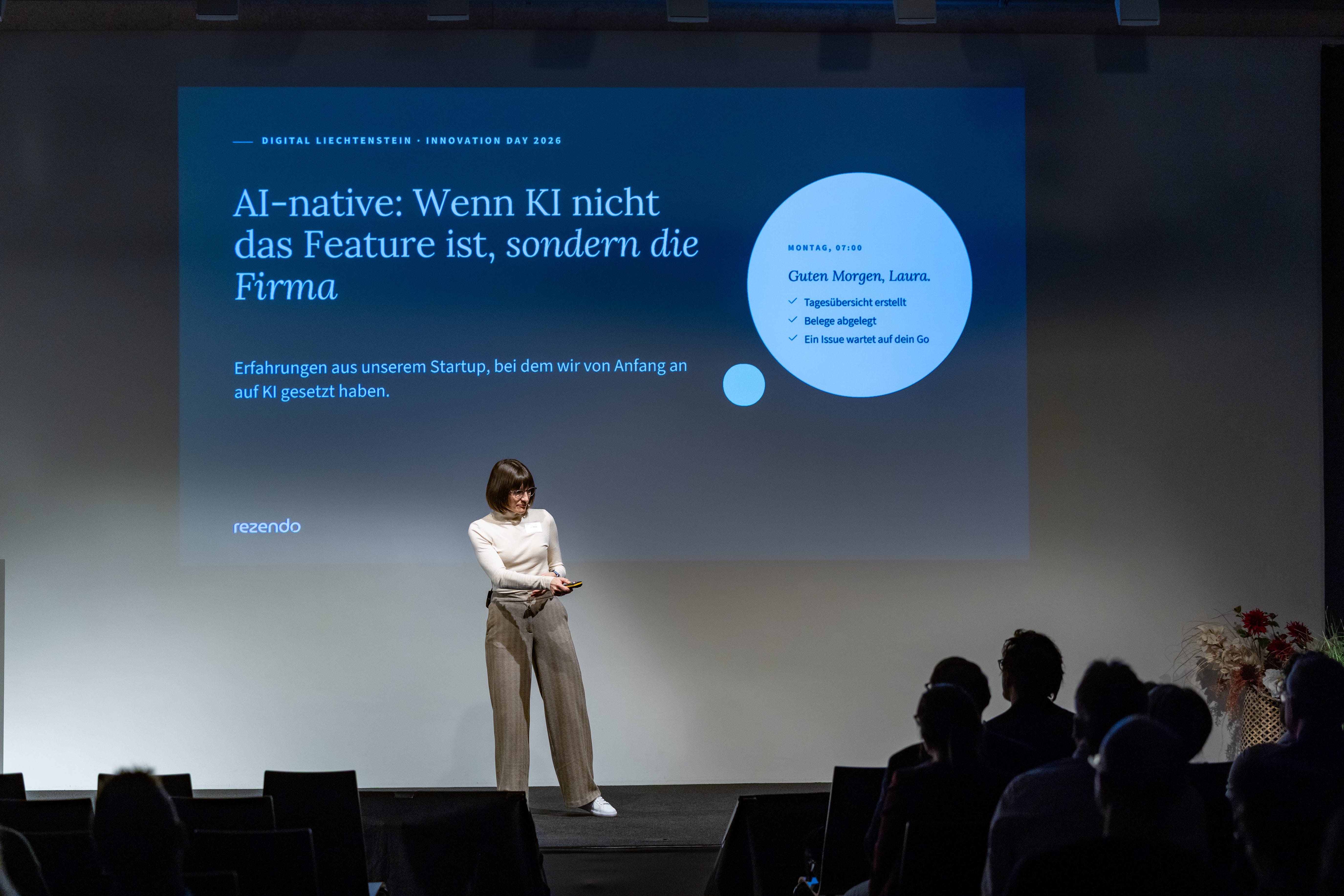
Photo: Daniel Schwendener
Three stages of AI use
Building on Gartner, Laura distinguishes three stages:
- AI users: Individuals use AI. If it goes away, that is annoying.
- AI-enabled: AI speeds up processes. If it goes away, work goes back to being done by hand.
- AI-native: AI is central to the business model and to how value is created. Without it, the service would not be possible in this form.
What matters is not the number of tools but the role AI plays in creating value. One simple question shows where a company stands: what would stop working tomorrow if AI suddenly disappeared?
People, AI, people
At Rezendo, every project starts with a personal conversation about goals. People decide what a survey should answer and carry the responsibility. In between, the AI takes on the work that grows with every additional participant: it prepares the survey, conducts the AI-moderated interviews, analyses the answers and produces the report and recommendations. At the end, people check the quality again and present the results.
“People define the goal and carry the responsibility. AI takes on the scalable work in between.”
A company memory for the AI
For us, AI-native is not only about the product but also about how we work internally. For AI to work alongside us on its own, it has to understand the company. That is why we keep knowledge, meeting notes, decisions and the product vision in one place, our company context. It answers three questions: where does which knowledge live? Who decided what, and why? Where is work on what happening? That way nobody has to explain everything to the AI from scratch each time.
A development task shows what this looks like day to day. A new product idea used to cost Laura a lot of time and nerves. Today she describes the idea in plain language. The AI turns it into a structured development task, and a development agent presents it to her co-founder Bernhard Wanger for approval. Implementation, tests and quality checks follow. A person approves the release. That leaves more time for the what and the why, and less for tedious preparation.
Fast does not mean good
A LinkedIn campaign with images, copy and set-up in Ads Manager came together with AI in one day instead of a week. Laura was thrilled, but the ads did not deliver what she had hoped for. Together with the AI, she improved the campaign step by step.
What proves itself, we capture as skills: instructions for recurring workflows that carry experience and feedback forward to the next time. Around them sits a harness, a framework of rules and tests in the software. The more independently the AI works, the more important this quality control becomes. Good results have to be reproducible and verifiable.
AI in everyday work, responsibility with us
Beyond the product, too, the AI works alongside us:
- Strategy: it researches competitors and target customer profiles.
- Start of the day: it brings appointments, tasks and projects together into one overview.
- Customer work: it supports us from kick-off to presentation.
- Accounting: it prepares receipts and bookings, and a person checks them.
The AI prepares and works alongside us. Decisions and responsibility stay with us.
Separate data first, then connect
Anyone who builds AI deeply into their company needs to know where which data lives. At Rezendo, participants' data is hosted and processed in Switzerland. Our company knowledge lives locally and is versioned in Git. The AI assistants we use for project work never see participants' data. First we classify data and set boundaries, then we connect systems deliberately.
Six learnings
- Start: with a concrete process, ideally one nobody likes.
- Keep going: it is slower at first and takes work off your plate later.
- Document: knowledge and the reasons behind decisions.
- Separate data: before systems are connected.
- Keep approvals: responsibility lies with people.
- Feedback loops: keep improving the ways you work with AI.
The closing question
What would stop working for you tomorrow if AI suddenly disappeared? Perhaps everything would still keep running today. AI-native does not mean using many tools but redesigning how value is created. For Laura's son, talking to devices is a matter of course. Just as naturally, AI will take on its first tasks in companies.
“The question is not only what AI can do, but how we shape our companies with it.”